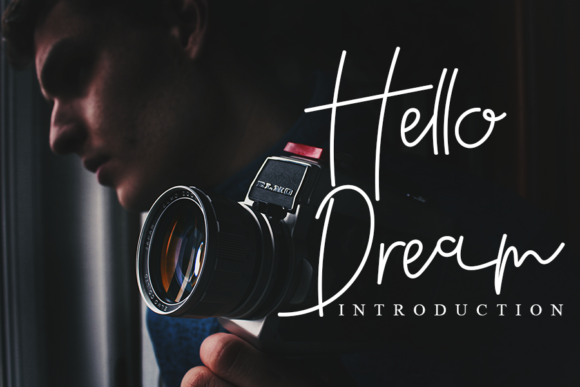
Hello Dream: A Timeless Script Handwritten Font for Editorial Calm
It was a quiet Tuesday morning—coffee cooling beside my laptop—when I opened the cover layout for a new digital magazine feature on slow living. The headline needed warmth, not flash; elegance, not fuss. I tried three serif fonts, two minimalist sans serifs, then paused. What if the voice of the piece wasn’t in precision—but in presence? That’s when I reached for Hello Dream. Not as a decorative afterthought, but as an intentional editorial decision: a Script Handwritten font that breathes with the rhythm of thoughtful content.
Hello Dream for Wedding Invitations and Elegant Branding
There’s a reason Hello Dream feels instantly at home on wedding invitations—it doesn’t shout; it leans in. Its relaxed handwritten character carries weight without stiffness, intimacy without informality. As a Script Handwritten typeface, it offers subtle variation in stroke width and natural entry/exit terminals, giving each letter a gentle pulse. In print, it holds its grace at 24–36 pt for invitation headers and monogram accents. On screen, it works beautifully in PDF-based wedding guides or printable RSVP cards—especially when exported with embedded fonts to preserve spacing and ligature flow. Because Hello Dream is a premium Fonts release, it includes OpenType features like contextual alternates and discretionary ligatures, letting you refine tone: a softer “&” for romantic stationery, a lifted “t” for delicate envelope addressing. Just remember—it’s a display font, not body text. Reserve it for moments that deserve pause: names, dates, vows, and the quiet space between them.
Hello Dream for Lifestyle Blog Headers and Newsletter Graphics
I tested Hello Dream across three blog header iterations for a seasonal lifestyle newsletter—each time pairing it with a warm, highly readable serif (like Adobe Garamond Pro) for body copy. The contrast worked because Hello Dream doesn’t compete; it invites. Its even baseline and generous x-height mean it remains legible at smaller sizes than many script fonts—think 28–32 pt for email banner text or 40+ pt for blog mastheads. On mobile, it scales cleanly in responsive HTML emails when used as web-safe fallbacks aren’t possible—just be sure to embed the WOFF2 version and set a graceful sans-serif fallback (e.g., “Hello Dream”, -apple-system, BlinkMacSystemFont, sans-serif). As a Script Handwritten font, it softens digital sharpness without sacrificing clarity—perfect for creators who want their voice to feel human, not algorithmic.
Hello Dream for Printable Planners and Coaching Workbooks
In a recent coaching workbook redesign, I used Hello Dream for section dividers, weekly intention headers, and reflective journal prompts. Why? Because handwritten energy signals permission—to pause, to reflect, to write freely. As a Script Handwritten font, Hello Dream avoids the rigidity of calligraphic scripts while retaining authenticity. It’s legible enough for printed PDFs at 18–22 pt, yet expressive enough to distinguish “Your Vision” from “Next Steps.” But here’s what matters practically: before finalizing any printable, I checked the font’s included file formats (OTF and TTF), confirmed commercial licensing covers digital downloads, and verified multilingual support covered basic accented characters used in English-language coaching materials. Not all Fonts offer this—Hello Dream does, thoughtfully.
Hello Dream for Social Media Graphics and Digital Magazine Covers
“Eye-catching socia” isn’t just marketing phrasing—it’s a real need. When designing Instagram carousels for a digital magazine’s “Mindful Mornings” series, I used Hello Dream for slide titles overlaid on soft-lit photography. Its relaxed cadence created visual breathing room amid busy feeds. As a Script Handwritten font, it adds texture without clutter—ideal for quotes, episode titles, or limited-word headlines where every glyph must earn its place. For magazine covers, I paired Hello Dream with a crisp, neutral sans serif (like Inter or Montserrat) for subtitles and credits—letting the script shine as a focal point, not a full layout. One caveat: avoid using Hello Dream for captions, dense lists, or small annotations. Its charm lives in spaciousness—not density.
Hello Dream for Recipe Ebooks and Editorial Pull Quotes
A recipe ebook isn’t just instructions—it’s mood, memory, invitation. I used Hello Dream for chapter openers (“Spring Greens,” “Late-Night Baking”) and pull quotes (“My grandmother stirred this batter by hand—no timer, no rush”). Its timeless quality grounds the content in tradition without feeling dated. As a Script Handwritten font, it supports narrative flow: readers don’t scan; they settle in. For PDF exports, I embedded the font and tested rendering across macOS, Windows, and iOS—no glyph substitution occurred. And because Hello Dream is a well-structured Fonts family, I could confidently use it across multiple digital products—ebooks, worksheets, branded templates—knowing licensing permits commercial reuse. Just skip long paragraphs or footnotes: this is a display font, designed for resonance, not repetition.