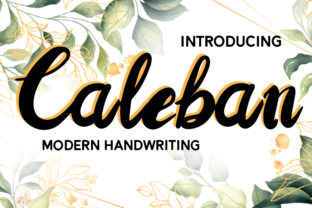
Caleban: A Friendly Handwritten Font for Small Business Branding
As a small business owner who designs my own packaging, social posts, and product labels, I know how much a single Script Handwritten font can shape how customers feel about my brand before they even read a word. Caleban is that rare Fonts choice — warm, approachable, and effortlessly charming — without looking childish or hard to read. It’s not just another decorative script; it’s a practical, versatile Caleban typeface built for real-world use across touchpoints where personality matters most.
Caleban for Instagram Captions and Story Text Overlays
When your Instagram feed is full of flat stock photos and generic sans serif text, Caleban stands out instantly. Its natural flow and subtle bounce make captions feel human—not algorithmic. I use Caleban as a display font for quote graphics, limited-time offer banners, and story highlights like “New Arrivals” or “Behind the Scenes.” Because it’s a Script Handwritten font with generous letter spacing and open counters, it stays legible even at small sizes on mobile screens. Unlike overly tight or ornate scripts, Caleban doesn’t sacrifice clarity for charm—making it ideal for quick-scrolling audiences.
Caleban for Product Labels and Handmade Packaging Design
If you sell candles, bath salts, greeting cards, or small-batch food items, your label is often the first physical interaction customers have with your brand. That’s why I switched to Caleban for all front-facing product names and flavor descriptors. Its friendly, hand-drawn texture reinforces authenticity—especially important when selling handmade or locally made goods. As a Fonts option, Caleban works beautifully on kraft paper, matte stickers, and soft-touch labels. Just avoid using it for tiny legal disclaimers or ingredient lists; reserve those for a clean sans serif. Pair Caleban with a light-weight sans (like Montserrat Light or Inter) to keep hierarchy clear and professional.
Caleban for Café Menus and Local Business Signage
My neighborhood café uses Caleban for daily chalkboard specials and laminated menu headers—and guests consistently comment on how “inviting” the typography feels. That’s the power of a well-chosen Script Handwritten font: it signals warmth, care, and local character. Caleban holds up well in print and vinyl cut applications because its strokes are consistent and its baseline is stable. For signage, I use it at 36–60pt for headings, then drop to a readable serif (like Lora or Merriweather) for descriptions and pricing. This pairing keeps things cohesive but highly scannable—critical when someone’s ordering coffee before their morning meeting.
Caleban for Wedding Invitations and Boutique Branding
Boutique owners and wedding stationers love Caleban because it adds elegance without formality. It’s not overly calligraphic or stiff—it’s relaxed, joyful, and personal. When designing invitation suites for local clients, I use Caleban for names and event details, then pair it with a crisp serif for addresses and RSVP instructions. The contrast feels intentional and refined. As a Fonts investment, Caleban pays off across digital invites, printed envelopes, welcome signs, and even fabric tags for bridal party robes. Its consistency helps build a unified visual language that clients remember—and refer.
Caleban for Website Headers and Email Newsletter Subject Lines
Your website banner and email subject line are two of the highest-impact places to reinforce brand voice—and both benefit from expressive typography. Caleban shines here as a headline font that says “we’re thoughtful, creative, and human.” I embed it via @font-face for H1s and hero section text, then fall back to a system font for body copy. On email, I convert Caleban to outlined text for subject lines used in Canva or Mailchimp templates—ensuring the friendly tone comes through even before the inbox preview expands. Just remember: always test how Caleban renders on iOS vs. Android, and never use it for long paragraphs or navigation menus.
Caleban for DIY Stickers, Thank-You Cards, and Customer Touchpoints
The little moments matter—like the handwritten-style note tucked into a customer’s order or the sticker sealing their package. Caleban makes those micro-experiences feel special without extra design time. I’ve used it for “Thank You!” seals on shipping boxes, “Hand-Poured With Love” tags on candle jars, and even custom sticker sheets for loyalty programs. Because Caleban is a Script Handwritten font designed with natural variation—not rigid uniformity—it avoids the “too perfect” look that undermines handmade credibility. And yes, it’s licensed for commercial use, so you can confidently apply it to physical products, digital templates, and client deliverables.
Caleban Font Pairing Ideas for Balanced Brand Identity
A great Script Handwritten font needs thoughtful support. Here’s what works with Caleban:
- For packaging & print: Pair with a warm, neutral serif like Cormorant Garamond or Playfair Display for body text and fine print.
- For web & social: Use Inter or Poppins as your go-to sans serif—clean, modern, and highly legible alongside Caleban.
- For luxury-leaning brands: Try a delicate slab serif like Rockwell or a low-contrast serif like PT Serif for quiet sophistication.
Caleban Commercial License Considerations for Entrepreneurs
Before using Caleban on merchandise, packaging, or digital templates you sell, double-check the license. Most reputable Fonts providers offer a standard commercial license covering unlimited impressions, physical products, and resale—just confirm it includes “embedding in digital downloads” if you sell Canva templates or printable planners. Avoid free alternatives that lack proper licensing—they risk takedowns or legal exposure. With Caleban, you’re investing in a premium font built for real business use, not just aesthetics.