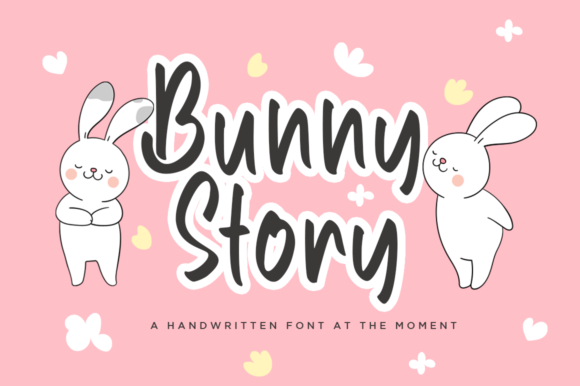
Bunny Story Handwritten Font for Makers
It started with a candle label — one of those quiet, late-night design sessions where the scent of vanilla soy wax still lingers in the air and your Cricut’s cutting mat is dusted with glitter residue. I’d just finished sketching a new spring collection: “Lavender Hush,” “Honeycomb Dawn,” “Meadow Whisper.” Sweet names. Soft vibes. But the font felt off — too stiff, too generic, too *digital*. That’s when I opened Bunny Story. Within minutes, my label mockup softened, warmed, breathed. Bunny Story is a sweet and friendly handwritten font — not overly ornate, not cartoonish, not coldly perfect. It’s got gentle pressure variation, subtle entry/exit strokes, and that lovely uneven baseline that makes it feel truly hand-drawn. As a Script Handwritten font, it lands somewhere between relaxed charm and quiet elegance — like ink dipped from a favorite fountain pen and guided by a calm, confident hand.
Bunny Story for Wedding Invitations and Elegant Branding
I tested Bunny Story on a set of digital wedding invitation suites — save-the-dates, main invites, RSVP cards, and menu prints. The result? Instant warmth. Bunny Story shines in titles and names — “Emma & James,” “Join Us on May 18th,” “Dinner Begins at Seven.” Its natural flow gives even simple phrases a handmade soul. Because Bunny Story is a Script Handwritten font with generous letter spacing and open counters, it remains legible at 14–18pt on printed cardstock — especially when paired with a clean sans serif (I used Montserrat Light for body text). No ligatures or swashes clutter the design; instead, Bunny Story offers subtle alternates that let you swap a bouncy “g” or a looping “y” for visual interest without sacrificing readability. For boutique stationery sellers, this means consistent, elevated branding across physical and digital touchpoints — all while staying true to the soft, romantic tone your couples love.
Bunny Story on Product Labels and Handmade Packaging
Back to those candles — this time, full packaging: kraft labels, matte sticker sheets, and cotton twine tags. Bunny Story holds up beautifully at 10–12pt on 2" x 1.5" labels when printed at 300dpi. It reads clearly under natural light and scans well for Etsy listing thumbnails. As Fonts go, Bunny Story isn’t built for dense ingredient lists or regulatory text — skip using it for “Soy Wax • Cotton Wick • Phthalate-Free Fragrance Oil.” But for brand name, scent title, and short descriptors (“hand-poured • small batch • made in Oregon”), it adds instant artisanal credibility. I also used it on recycled paper gift tags for a spring mini-collection: “For You,” “With Love,” “Just Because.” Each tag felt personal, intentional, tactile — exactly what handmade shoppers connect with. Bonus: Bunny Story includes both OTF and TTF files, so it loads reliably in Canva, Adobe Illustrator, Silhouette Studio, and Cricut Design Space.
Bunny Story for Printable Wall Art and Digital Downloads
When designing printable wall art for a seasonal shop refresh — think “Bloom Quietly,” “Tend Your Garden,” “Spring Is a Verb” — Bunny Story became my go-to display font. Its unique rhythm and organic weight shifts give phrases movement and mood without needing extra graphics. As a Script Handwritten font, it avoids the sterility of overused brush fonts while staying versatile enough for farmhouse, cottagecore, botanical, or minimalist aesthetics. I layered it over soft watercolor textures and paired it with a thin serif (Cormorant Garamond) for subtle contrast — no clashing, no competition. For digital download creators, Bunny Story works cleanly in PDF previews and PNG mockups. Just remember: avoid scaling it below 16px for web use, and always embed the font if exporting editable templates (check your commercial license — Bunny Story is cleared for commercial use, including resale of physical products and digital printables).
Bunny Story on Merchandise Like Tote Bags and Mugs
I ran a quick test on a cream canvas tote: “Good Things Take Time” in Bunny Story, heat-pressed with soft-touch vinyl. The curves held. The spacing stayed graceful. No awkward gaps or cramped letters — even around the curve of the bag’s side seam. Same went for a ceramic mug mockup: “Hello, Sunshine” arched gently along the rim. Bunny Story’s moderate x-height and open letterforms translate well to curved surfaces and fabric textures. That said, for small embroidery or fine-detail iron-ons under 0.5", I’d recommend simplifying to key words only — “Sunshine” alone, not the full phrase. And while Bunny Story is absolutely charming for slogans and short quotes, it’s not ideal for long paragraphs, care instructions, or size charts on garment tags. Save those for a crisp, functional sans serif. Let Bunny Story do what it does best: invite, delight, and humanize.
Bunny Story for Sticker Sheets and Planner Pages
My latest sticker sheet — pastel-toned, floral-framed, designed for bullet journaling and gift wrapping — leaned heavily on Bunny Story for headers, icons (“Notes,” “Gratitude,” “Dream Big”), and decorative accents. Because Bunny Story is a sweet and friendly handwritten font, it adds playfulness without looking childish. On 1.25" circle stickers, it remained legible at 10pt. On planner page headers (A5 size), it gave structure and softness in equal measure. One tip: when prepping SVG files for cutting machines, outline Bunny Story text before saving — some alternates behave unpredictably in Silhouette or Cricut software unless converted. Also, double-check file formats: Bunny Story includes standard Latin characters and basic punctuation, but no extended language support (no Cyrillic, Greek, or Vietnamese glyphs). Perfect for English-first makers — just know its scope before launching multilingual product lines.