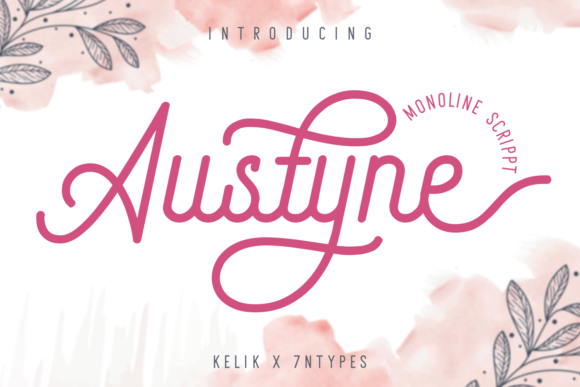
Austyne: A Delicate Script Handwritten Font for Elegant Branding
It started with a blank mood board and a client email: “We’re opening a small ceramic studio—think handmade mugs, quiet mornings, and soft light.” No logo yet. Just intention. I opened my fonts folder, scrolled past the bold sans serifs and classic serifs, and landed on Austyne. Instantly, it felt like the right kind of quiet confidence—a Script Handwritten font that doesn’t shout, but lingers.
Austyne for Ceramic Studio Logos and Handmade Brand Identity
I dropped Austyne into a simple wordmark mockup: just the studio’s name in all lowercase, centered over a raw clay texture. The flow was immediate—the tapered terminals, gentle curves, and balanced spacing gave warmth without fragility. As a Script Handwritten font, Austyne avoids the overly ornate or stiffly formal traps many script fonts fall into. It’s delicate, yes—but also grounded. That balance made it work across scales: crisp at 48pt on a website hero banner, legible at 18pt on a business card, and expressive even at 36pt on a matte-finish product label.
Austyne for Product Labels and Packaging Design
We printed test stickers using Austyne for mug bottom labels—“Hand-thrown • Small Batch • Made in Portland.” Because Austyne is a delicate, elegant and flowing handwritten font, it softened the technicality of production details without sacrificing clarity. Its well-balanced characters ensured “Small Batch” didn’t visually collapse or compete with the ceramic form itself. For packaging, we paired Austyne with a warm, low-contrast serif for body text—creating hierarchy while keeping the voice cohesive. As a Fonts choice for tactile goods, Austyne reinforced craft, care, and continuity between digital and physical touchpoints.
Austyne for Instagram Posts and Social Media Graphics
On Instagram, where attention lasts seconds, Austyne became our secret rhythm keeper. We used it only for short phrases—“New glaze drop,” “Studio hours,” “Join us Saturday”—never full paragraphs. As a Script Handwritten font designed for impact, not endurance, Austyne thrived in tight compositions: overlaid on neutral-toned flat lays, aligned left against a subtle linen texture, or centered beneath a photo of drying slip-cast forms. Its PUA encoding meant we could access stylistic alternates directly in Figma and Illustrator—swapping in a swash capital “S” for “Studio” or a connected “th” ligature for visual polish, no workarounds needed.
How Austyne Works With Other Fonts in Real Brand Systems
Pairing Austyne isn’t about contrast for contrast’s sake—it’s about harmony with purpose. We tested it beside three type families: a warm humanist sans (for clean, approachable captions), a gently modulated serif (for editorial depth in workshop descriptions), and even another restrained script (which clashed—too much motion). Austyne shines brightest when paired with typefaces that breathe *with* it—not against it. Think: generous letter-spacing in the supporting font, open counters, and shared x-height sensitivity. As a Fonts asset, Austyne isn’t meant to carry long copy, but it elevates every headline, tagline, and accent moment with intention.
Austyne for Wedding Invitations and Elegant Branding
Later that month, a friend asked for help designing her wedding stationery—minimal, botanical, and quietly romantic. Again, Austyne was first in the lineup. Why? Because Austyne is a delicate, elegant and flowing handwritten font that conveys sincerity without cliché. On thick cotton paper, its fine hairlines held beautifully in letterpress; on digital invites, its PUA-encoded glyphs rendered cleanly across devices. We used it for names and dates only—letting white space and texture do the rest. It didn’t try to be everything; it simply *was* the tone.
Austyne for Business Cards and Printed Marketing Materials
For the ceramic studio’s business cards, we set the name in Austyne at 24pt, then added a thin line break before the contact info in a light-weight sans. The result? Instant recognition, zero noise. No need for icons or extra flourishes—Austyne carried the personality. As a Script Handwritten font built for real-world use, it scaled flawlessly from 12pt (on a tiny sticker inside a box) to 72pt (on a framed studio sign). Its consistent stroke modulation meant no awkward thinning or blotching in print—critical for designers ordering physical assets.
Testing Austyne Before Full Brand Rollout
Before locking in Austyne across the brand system, I ran three quick checks: First, printed a full character set at 14pt to verify readability of lowercase “a,” “e,” and “g”—all clear, open, and distinct. Second, tested color contrast on both light and dark backgrounds—its medium contrast worked cleanly on cream, charcoal, and oat. Third, exported a few social templates and opened them on iPhone and iPad to confirm PUA glyphs stayed intact. Simple steps—but they saved time later. As a Fonts purchase, Austyne includes full Latin support and intuitive OpenType features, making it reliable for commercial projects without surprises.
Austyne for Website Headers and Editorial Design
On the studio’s homepage, Austyne appears only in the main headline—“Clay • Fire • Quiet”—set large, with ample tracking. Below it, body text switches to a friendly serif. This restraint lets Austyne function as a true display font: memorable, atmospheric, and intentionally limited. In editorial layouts—like a seasonal newsletter or workshop PDF—we used it for section dividers (“This Month,” “New Tools,” “Behind the Wheel”)—always short, always intentional. Its elegance never feels forced because Austyne is a delicate, elegant and flowing handwritten font rooted in proportion, not pretense.
If you’re selecting Fonts for a brand that values craft, calm, and authenticity, Austyne earns its place—not as decoration, but as voice. It’s a Script Handwritten font with quiet authority, built for moments that matter most: the first glance, the held breath, the slow smile. And when your client runs their finger over a printed label and says, “Yes—that’s us,” you’ll know why Austyne was worth every pixel.